

$1M donation from ECE alumni leads to Scholar AI upgrade
Thanks to a donation to the Elmore Family School of Electrical and Computer Engineering (ECE), Purdue’s Scholar cluster has been upgraded with 96 NVIDIA DGX Sparks to enhance artificial intelligence (AI) research and education at Purdue. By adding the DGX Sparks to Scholar, Purdue has increased its capacity to teach AI competency in courses across the university.
Jeff Fisher, a 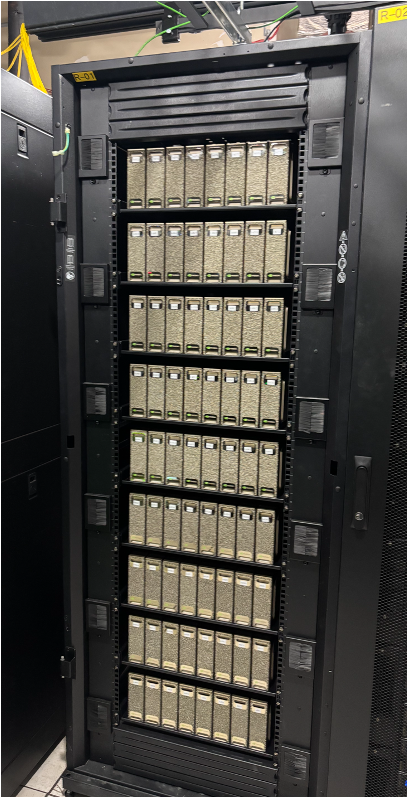 senior vice president at NVIDIA, and his wife Edie Fisher, both Purdue alumni (BS electrical engineering ’80 and BS retail management ’80, respectively), recently donated $1M to procure and deploy NVIDIA DGX Sparks for the purpose of enhancing education and research at Purdue. The DGX Spark is designed as a compact, desktop “personal AI supercomputer.” Built around NVIDIA’s GB10 Grace Blackwell Superchip, each system touts 1 petaFLOP of 4-bit precision AI Performance, 128 GB Unified Memory that can support AI models up to 200B parameters, as well as high-speed networking, all within a compact, mobile form that can fit inside a briefcase. By obtaining these compute systems, ECE is helping put advanced AI compute resources in the classroom, where they can be used for AI projects, class assignments, or hands-on instruction.
ECE is currently planning to leverage the DGX Sparks for three strategic use cases:
- Creating an AI “maker lab” for students at Purdue in Indianapolis.
- Making the DGX Sparks available to senior design teams to enable the pursuit of ambitious AI-related design projects.
- Incorporating the DGX Sparks into Purdue’s Scholar cluster to deploy in ECE accelerator and AI classes across campus.
For the first use case, 20 Sparks will be allocated for an on-site AI Maker Lab at Purdue in Indianapolis. This will provide the students there with immediate access to powerful compute resources reserved specifically for learning and experimenting with AI tools.
The second use case involves providing ECE senior design teams with the computational power needed for AI capstone projects. Ryan Beasley, ECE's Director of Instructional Laboratories, notes that the DGX Spark has opened up the AI landscape for ECE seniors.
“Because of the nature of senior capstone, historically, we have focused on small machine learning or machine vision models that have been trained using outside datasets,” says Beasley. “The Spark allows our students to fine-tune their models to fit what is needed specifically for their project, using public datasets that more closely mimic what they are looking for. The Spark also allows our students to use larger models while feeding in real-time information from sensors and user input. This opens up the scale of what projects can be accomplished."
The final use case benefits the university as a whole—upgrading the Purdue Scholar cluster. Scholar is a compute cluster designed specifically for classroom use; instructors utilize the system to give students hands-on experience with HPC and AI systems, with a user experience that is directly transferable to Purdue’s world-class community cluster systems. Augmenting the Scholar cluster with the DGX Spark systems has led to a threefold increase in GPU slots dedicated to students. By partnering with RCAC, ECE is maximizing the utilization and impact of this donation and helping to provide departments across Purdue with access to cutting-edge AI resources.
“The donation of the DGX Sparks provides Purdue with a substantial increase in our capability to train students in the HPC and AI skills they need for the STEM workforce,” says Preston Smith, Executive Director of RCAC. “Integrating them in Scholar is a low-cost, low-power way to provide students with the GPUs that have the performance and memory necessary to support today’s models.”
The DGX Sparks have entered production and will be field-tested in courses throughout the Fall 2026 semester at Purdue. For more information on Scholar, or to obtain access, please visit: Scholar Cluster Overview
The Elmore Family School of Electrical and Computer Engineering at Purdue University is a nationally ranked leader in education, research and innovation. With programs in West Lafayette and Indianapolis, Purdue ECE prepares students to tackle complex challenges and advance technologies that shape our world. Its faculty and students drive discoveries in areas including artificial intelligence, semiconductors, cybersecurity, communications and next-generation computing.
RCAC operates the centrally-maintained research computing resources at Purdue University, providing access to leading-edge computational and data storage systems as well as expertise and support to Purdue faculty, staff, and student researchers. To learn more about HPC and how RCAC can help you, please visit: https://www.rcac.purdue.edu/ or reach out to rcac-help@purdue.edu to request consultation.
Written by: Jonathan Poole, poole43@purdue.edu