

Purdue’s RSE Center is a major contributor to annual US-RSE conference
Last week, a team from the Purdue Center for Research Software Engineering (RSE Center) attended US-RSE 2026: Advancing Science in the Age of AI. The annual conference, held this year in San Jose, CA, from October 19-21, focused on exploring how RSEs and collaborators increase research impact while contending with a rapidly changing technological landscape. While there, Purdue RSE team members gave talks, led workshop sessions, joined panel discussions, presented papers, and participated in poster sessions. The team’s participation reaffirmed the importance of software in modern scientific discovery and bolstered Purdue’s position as a top research institution in the nation.
Research 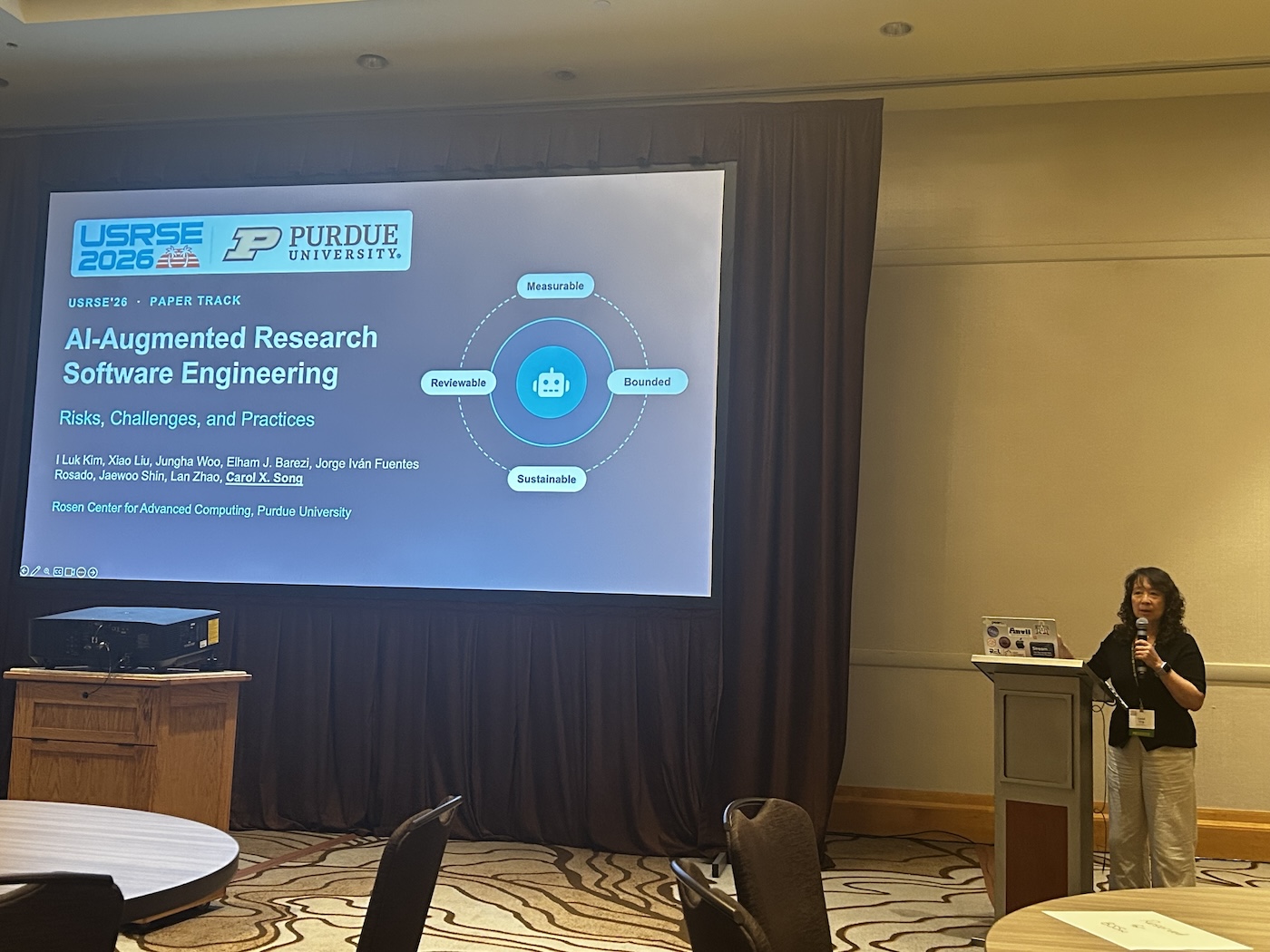 software engineering is a burgeoning field aimed at bridging the gap between traditional software expertise and domain-specific science. Many modern scientific workflows rely heavily on computing, but most researchers lack the strong knowledge base needed to build and deploy the intricate software programs required to solve their problems. RSEs (Research Software Engineers) are engineers who understand the full research lifecycle, through proposal development, experimental design, data workflows, scaling, compliance, and long-term maintenance. The United States Research Software Engineer Association (US-RSE) was created to support and grow RSE as a formal discipline. Part of their strategy for accomplishing this was to create an annual conference, bringing those who write and contribute to research software together in one shared space to problem-solve, communicate new ideas, and network. Purdue’s RSE Center, housed within the Rosen Center for Advanced Computing (RCAC), was a major contributor to US-RSE 2026, with team members presenting or co-leading nine different sessions throughout the week. A list of these sessions is as follows:
- Navigating RSE Team Operations: Leadership, Sustainability, and Emerging Challenges—Birds of a Feather Workshop led by Daniel Madren with further support from Laura Theademan, Geoffrey Lentner, and Chris Bentley
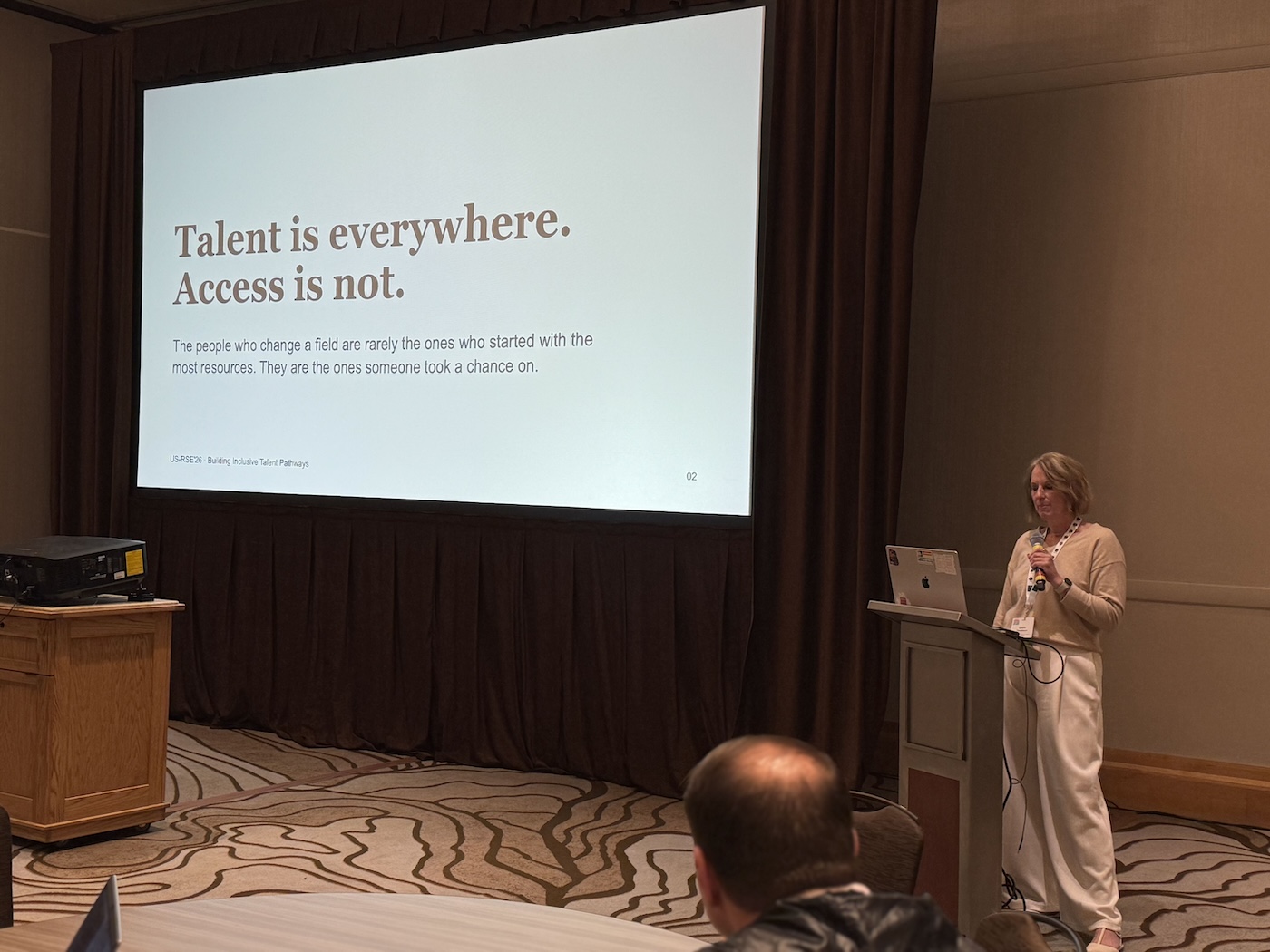
- Building Inclusive Talent Pathways: Scaling Outreach, Workforce Development, and Community Engagement for RSE—Accepted paper by Suzanna Gardner and Laura Theademan; presented by Theademan
- PLENARY KEYNOTE SESSION: Shaping What Comes Next: The RSE Role Today and Tomorrow—Carol Song was a keynote panelist for the discussion
- AI-Augmented Research Software Engineering: Risks, Challenges, and Practices—Accepted paper by Kim, I. L., Liu, X., Woo, J., Barezi, E. J., Fuentes Rosado, J. I., Shin, J., Zhao, L., & Song, C. X.; presented by Carol Song
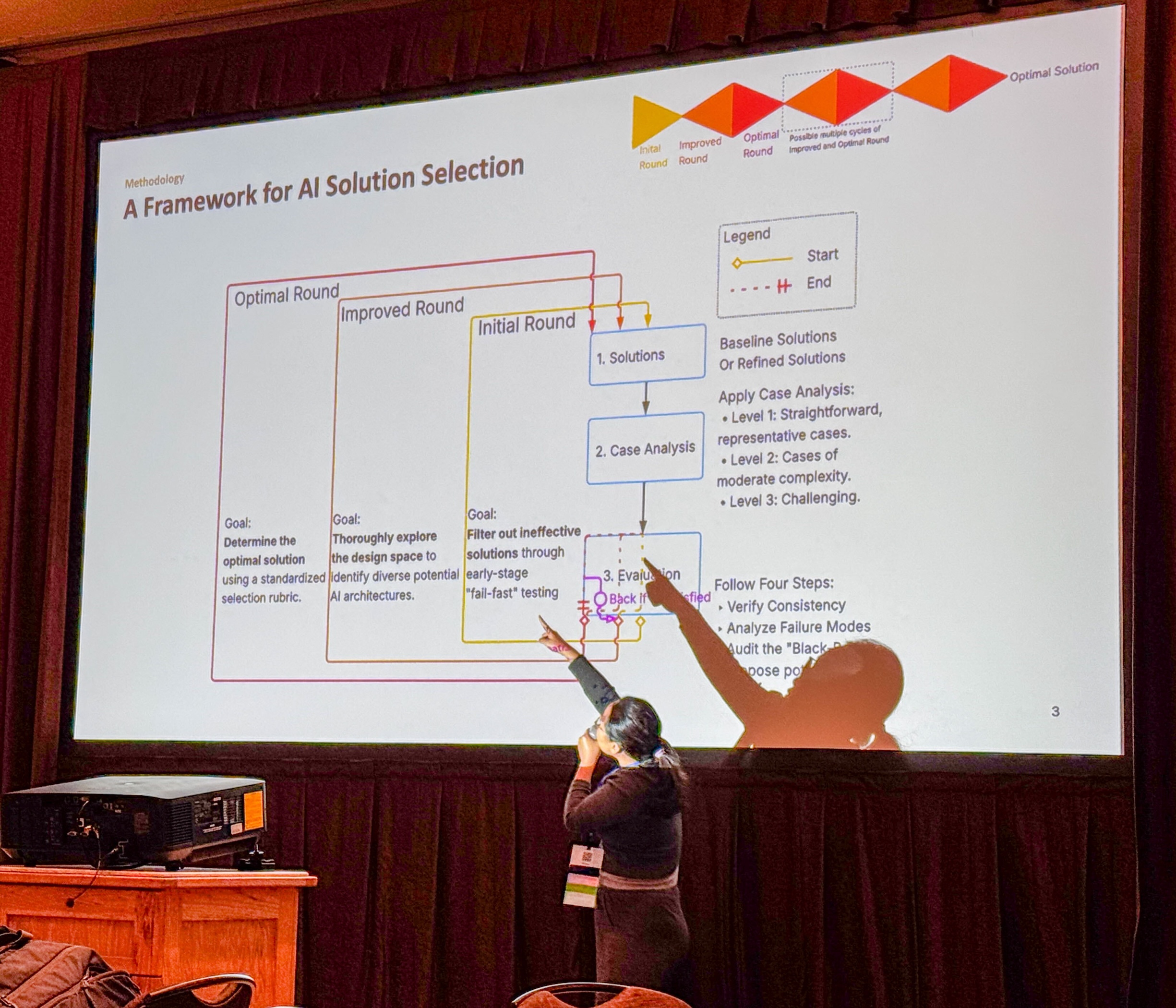
- A Framework for Evaluating AI-Integrated Research Software: Demonstration and Validation through CyberFaCES Smart Search—Accepted paper by Liu, X., Woo, J., Zhao, L., Shin, J., Kabuo, C., & Song, C; presented by Xiao Liu
- Building a Self-Improving Agentic Harness for RSE Projects—Accepted poster presented by Geoffrey Lentner
- Case Studies Demonstrating RSE Impacts—Chimdia Kabuo held the position of Talks Chair for this session
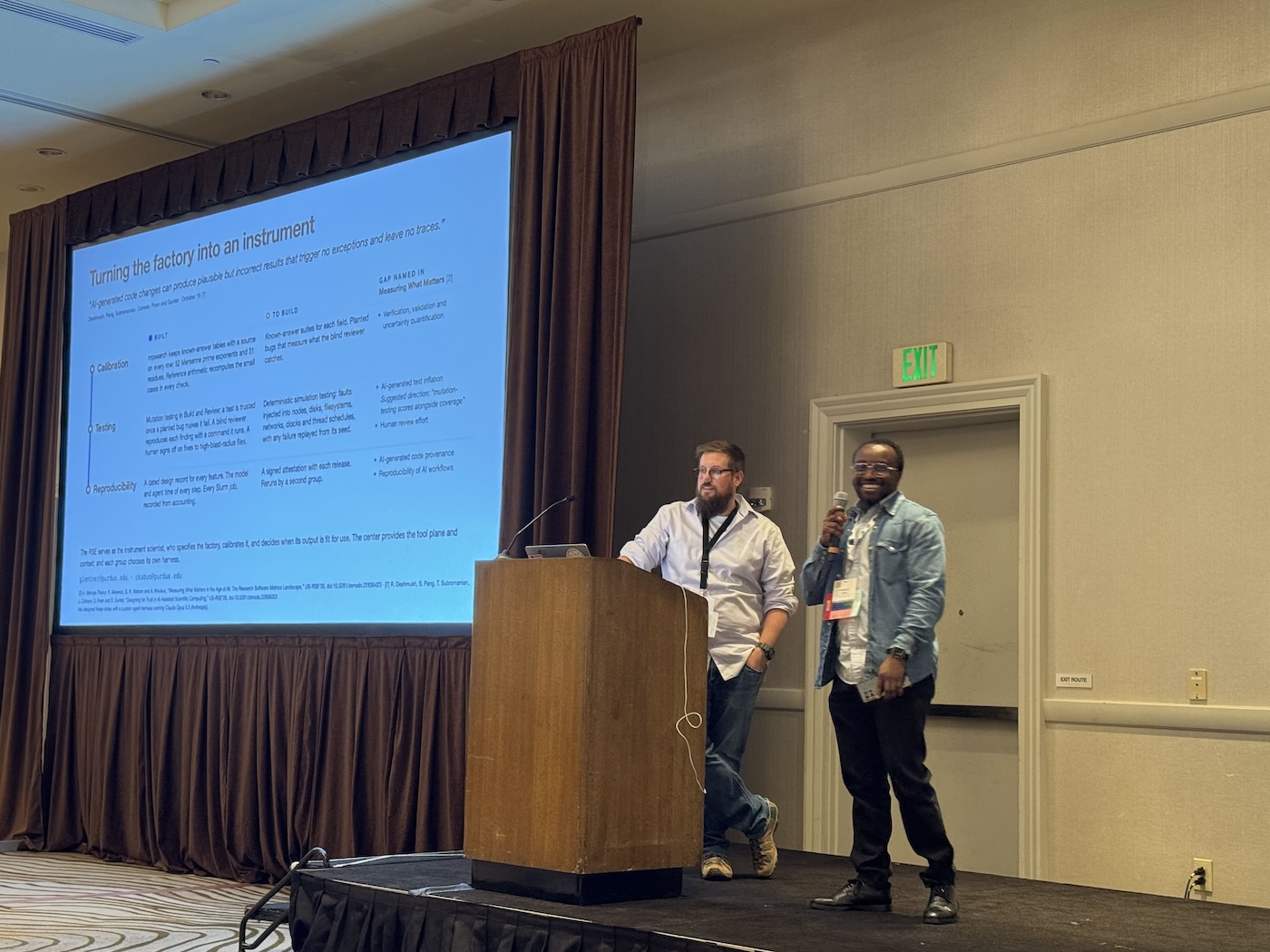
- On Trust: Adopting Autonomous Software Factories in RSE Organizations—Microtalk presented by Geoffrey Lentner and Chimdia Kabuo
- Student & Early Career—Chimdia Kabuo participated as a mentor throughout the week for the Student Mentorship program. Kabuo also served as a committee member for the Technical Program at the conference.
“US-RSE’26 was a great opportunity to connect with others in the research software engineering community, learn how teams are adapting to AI and other emerging technologies, and bring back practical ideas that can strengthen the way we support researchers at Purdue,” says Chris Bentley, the Assistant Director at the Purdue RSE Center. “We are excited to implement some of the concepts and look forward to participating again next year.”
The US-RSE 2026 conference was extremely productive for the Purdue RSE team, leading to new connections and enabling novel research software solutions to be brought back to the university. To learn more about the event as well as see a full list of proceedings and presentations, please visit: US-RSE 2026: Advancing Science in the Age of AI
Purdue Center for Research Software Engineering
Modern research increasingly depends on software that is reliable, scalable, and sustainable, yet most research teams lack the dedicated engineering capacity needed to develop and support the software. Let’s face it, as a researcher, you want the majority of your time focused on the research, not on code writing and complex data management. Purdue’s Research Software Engineering (RSE) Center was created to handle all of your software needs for you, letting you get back to what’s most important—the research itself.
The RSE Center provides end-to-end research software support, from early proposal design and data engineering to development, deployment, visualization, and long-term sustainability. We meet researchers where they are and work with you to turn your ideas into realities. No matter your software or project needs, we can help you take your next giant leap!
To learn more or request a consultation, please visit: Purdue RSE Center
RCAC operates the centrally-maintained research computing resources at Purdue University, providing access to leading-edge computational and data storage systems as well as expertise and support to Purdue faculty, staff, and student researchers. To learn more about HPC and how RCAC can help you, please visit: https://www.rcac.purdue.edu/ or reach out to rcac-help@purdue.edu to request consultation.
Written by: Jonathan Poole, poole43@purdue.edu