

Anvil supported 2026 Nobel Prize in physics for NSF IceCube neutrino discoveries
Francis Halzen, a Gregory Breit Professor and Vilas Research Professor in the Department of Physics at the University of Wisconsin–Madison, was awarded the 2026 Nobel Prize in Physics by the Royal Swedish Academy of Sciences for “decisive contributions to the IceCube Neutrino Observatory and the discovery of high-energy neutrinos of astrophysical origin.” Halzen is the principal investigator for the IceCube project, which collects and analyzes data involving extremely elusive neutrino particles. Part of the group’s work relies heavily on access to NSF-funded high-performance computing (HPC) resources, including Purdue’s Anvil supercomputer, delivered through the NSF’s Advanced Cyberinfrastructure Coordination Ecosystem: Services & Support (ACCESS) program.
Neutrinos are 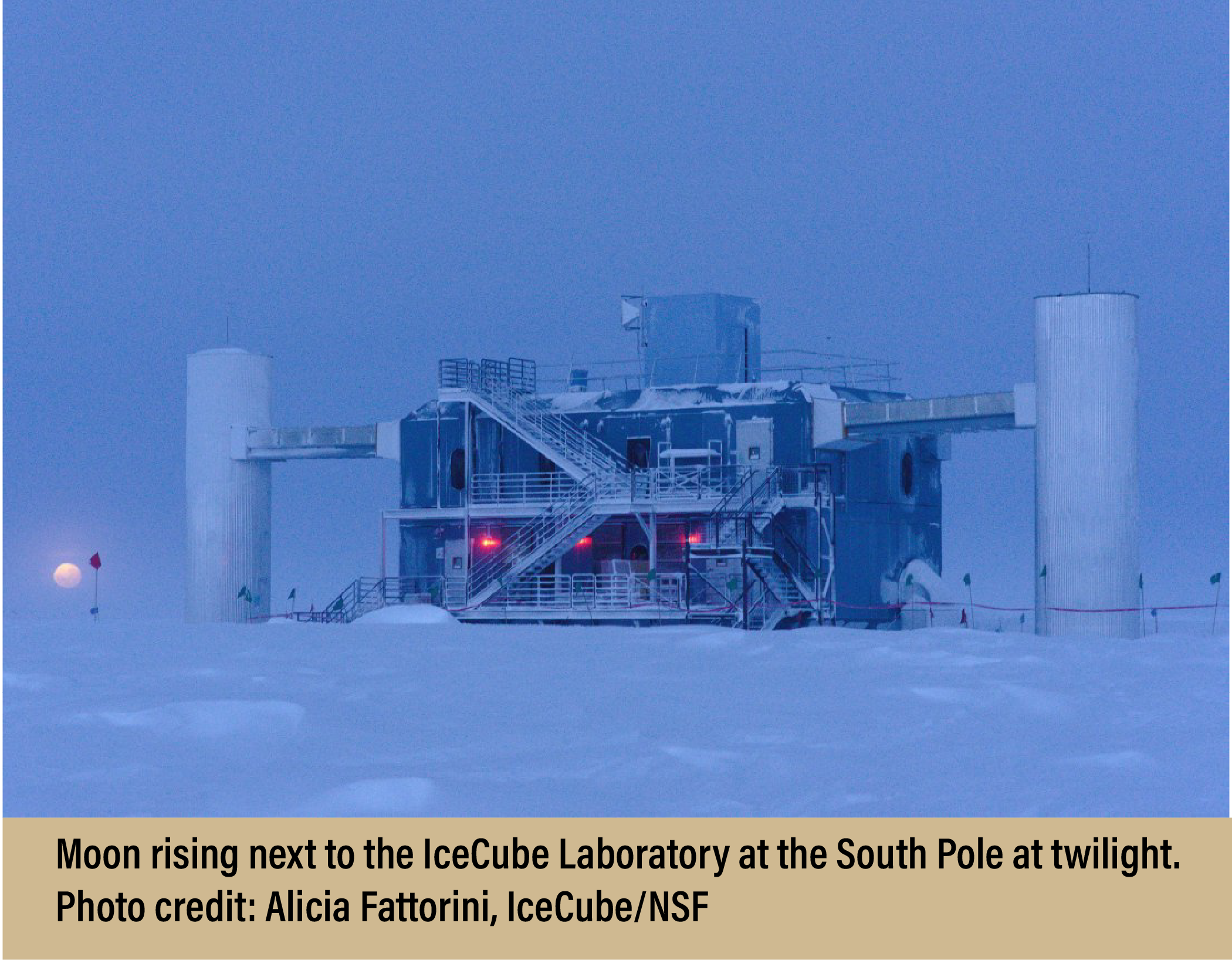 fundamental subatomic particles that possess no charge and nearly no mass. Due to these unique characteristics, neutrinos do not interact with electromagnetic forces or the strong nuclear force, and rarely with gravity or the weak force. In fact, neutrinos typically pass directly through matter, including Earth, with no discernible effect. This makes studying the particles extremely difficult. However, the elusivity of neutrinos is exactly what makes them worthwhile for study—because they interact with so little in the universe, they carry with them unaltered information about the cataclysmic astrophysical events (black hole formation, Big Bang, etc.) that created them. As Halzen himself put it in a 2014 Astronomische Nachrichten publication:
“High-energy neutrinos have a distinct potential to probe the extreme Universe. Neutrinos reach us from the edge of the Universe without absorption and with no deflection by magnetic fields. They can escape unscathed from the inner neighborhood of black holes and from the accelerators where cosmic rays are born.”
As noted, most neutrinos pass directly through the planet. Some, however, do occasionally collide with other subatomic particles, causing an interaction that leaves a trace. To view these interactions, and therefore to observe and study neutrinos, one must essentially set up sensors, then sit and wait. Scientists have known this since the early 1970s and determined that a particle detector at least one cubic kilometer in size would be required for the task. In the late ‘80s, Halzen realized the ideal location for such a detector would be inside ice, where sensor noise would be much lower than anywhere else. Thus the idea of the IceCube Neutrino Observatory was born.
The NSF approved initial funding for the IceCube project in 2002, and construction of the facility at the South Pole was completed in 2010. Soon after, results began rolling in, and with them, massive amounts of data. Currently, the IceCube observatory produces over one terabyte of data daily. This data then needs to be analyzed in order to derive any meaningful insights, which requires a substantial amount of HPC resources. To deliver both the data and the HPC power to researchers, the IceCube project relies on the NSF’s advanced computing portfolio, including the supercomputing resources coordinated through the ACCESS program.
“Anvil and ACCESS have been strong partners with IceCube for many years, supporting a diverse range of scientific analyses,” says David Schultz, Research Cyberinfrastruture Manager at the Wisconsin IceCube Particle Astrophysics Center. “ACCESS GPU resources are critical for accurately modeling the glacial ice at the South Pole, a necessity for understanding IceCube data.”
Purdue’s Anvil supercomputer has contributed significantly to the IceCube project via its ACCESS allocation. To date, IceCube has used nearly 160 million SUs (service units) on the system, the second-highest ACCESS machine usage for the project. While this is welcome news for the Anvil team, it was also not a surprise—IceCube is precisely the type of large-scale compute project that Anvil was designed for. The cluster boasts over 1000 compute nodes as well as 37 dedicated GPU nodes, 21 of which contain 4 NVIDIA H100s each. No matter the type of job needed by IceCube researchers, Anvil’s system can provide.
Purdue also supports the IceCube project by contributing HPC resources aside from Anvil to the Open Science Pool (OSPool). OSPool is a distributed high-throughput computing platform that connects resources from universities and national labs and organizes them as a single, virtual cluster. The IceCube team has run nearly 120,000 jobs thus far on Purdue systems via OSPool.
“Congratulations to Dr. Halzen for being awarded the Nobel Prize,” says Preston Smith, Executive Director of the Rosen Center for Advanced Computing (RCAC) at Purdue. “The IceCube team has achieved the extraordinary, and we’re proud to have our HPC resources contributing."
More information about the 2026 Nobel Prize in Physics can be found here: Nobel Prize Press Release. For more information on Dr. Halzen’s work and the IceCube project, please visit: IceCube Neutrino Observatory
To learn more about high-performance computing and how it can help you, please visit our “Why HPC?” page.
Anvil is one of Purdue University’s most powerful supercomputers, providing researchers from diverse backgrounds with advanced computing capabilities. Built through a $10 million system acquisition grant from the National Science Foundation (NSF), Anvil supports scientific discovery by providing resources through the NSF’s Advanced Cyberinfrastructure Coordination Ecosystem: Services & Support (ACCESS), a program that serves tens of thousands of researchers across the United States. Anvil also supports advanced artificial intelligence research as an official resource provider of the National Artificial Intelligence Research Resource (NAIRR) Pilot.
Researchers may request access to Anvil via the ACCESS allocations process or through the NAIRR allocations process. More information about Anvil is available on Purdue’s Anvil website. Anyone with questions should contact anvil@purdue.edu. Anvil is funded under NSF award No. 2005632.
Written by: Jonathan Poole, poole43@purdue.edu